Key Takeaways:
- A year ago the major sportsbooks’ daily actives fell 10% – 14% in the first two weeks of June. This year the same stretch grew them 52% – 111%.
- Combined user sessions of sportsbook and prediction market apps surged 35% during the first half of June compared to the same period in 2025.
- The combination of Kalshi and Polymarket owned a 73.5% share of betting market downloads in the first half of June.
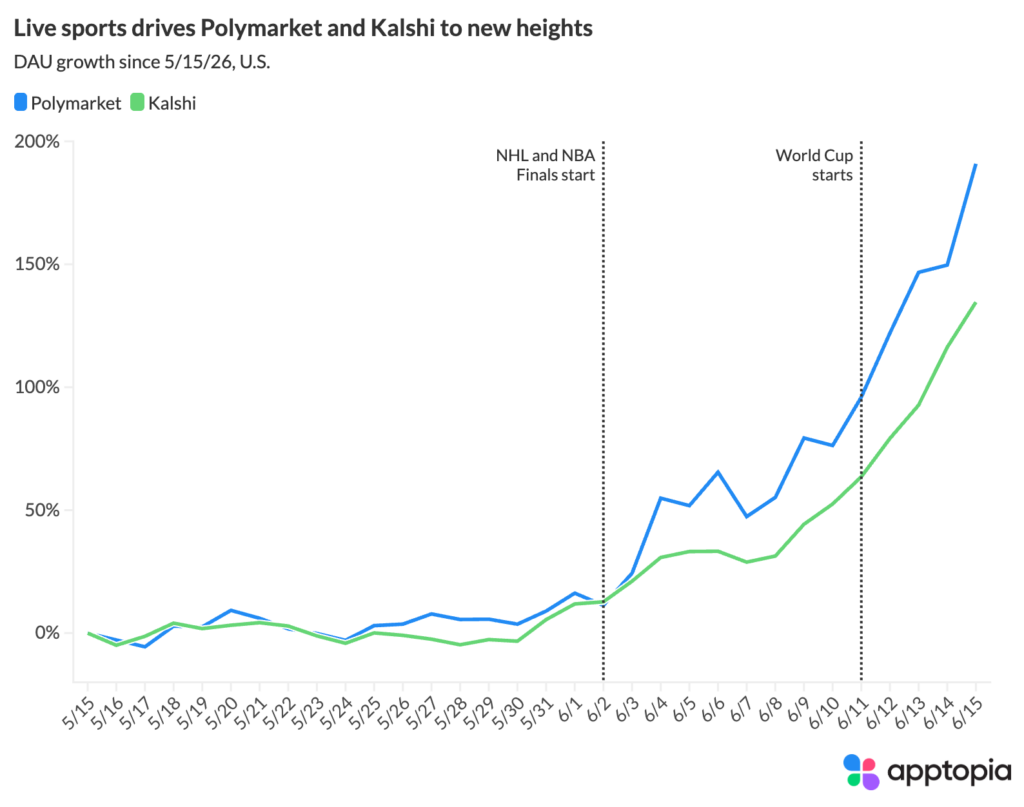
- Polymarket hit all-time highs for mobile app daily active users on June 13th, 14th, and 15th. Kalshi did the same on June 14th and 15th.
- Sports bettors are skewing younger, representing each app’s fastest growing user segment.
The 2026 FIFA World Cup, which kicked off June 11 in Mexico City, helped turn a normally quiet stretch of June into a strong two-week run for US betting apps. Combined user sessions for sportsbook and prediction market apps surged 35% during the first half of June compared to the same period in 2025.
Last June, DraftKings [NASDAQ: DKNG] daily actives fell 14% over the first two weeks, FanDuel [NYSE: FLUT] slipped 10%, while BetMGM [NYSE: MGM] and Caesars [NASDAQ: CZR] each dropped more than 10%. This year the same two weeks delivered daily-active growth of 111% for DraftKings, 96% for FanDuel, 64% for BetMGM, and 52% for Caesars. We did not include DraftKings’ and FanDuel’s standalone prediction market apps as they are relatively small and prediction markets are now a feature within the larger sportsbook apps.
Comparing the average number of daily active users for each app from June 1-15, 2025 to June 1-15, 2026, we see substantial increases. DraftKings is up 117%, FanDuel up 48%, BetMGM is up 42%, and Caesars is up 11%. I believe a much more interesting NBA Finals this year and the World Cup are the reason for this boon. Even with increased active users, FanDuel’s more granular engagement metrics are down. Average Sessions per DAU are down 33.8% year-over-year in June while DraftKings’ are up 38.3%. Not only that, but DraftKings is showing almost 2x more sessions per DAU than both FanDuel and Kalshi.
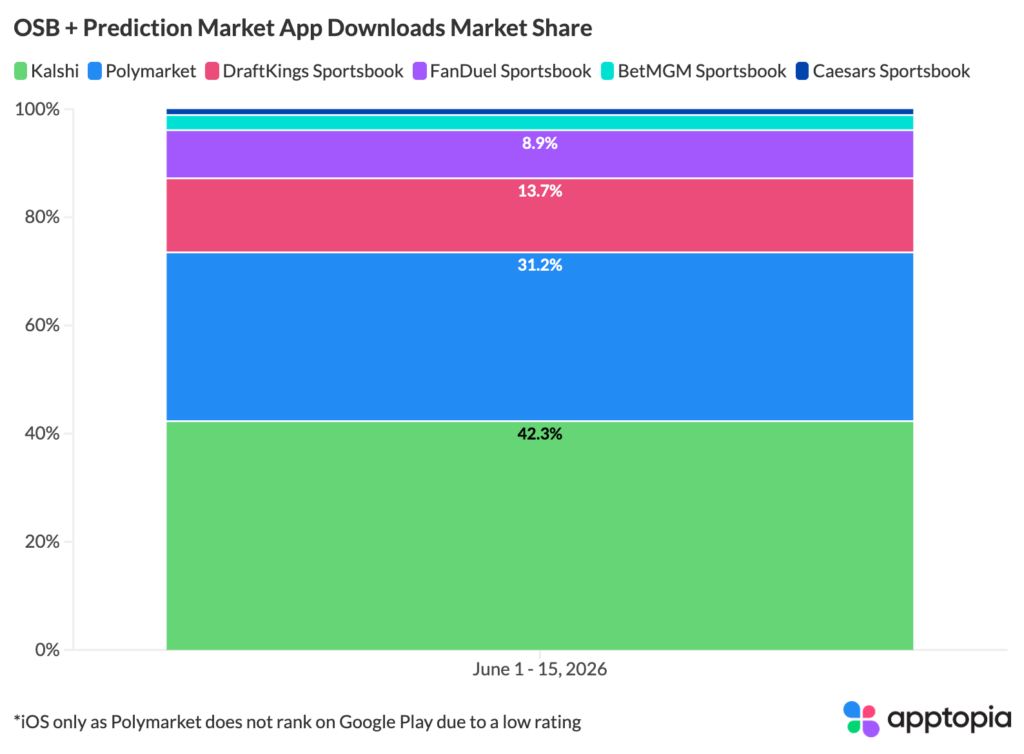
Introducing Kalshi and Polymarket changes things. So far in June, Kalshi owns almost 42.3% of new app installs for the major OSB and prediction market apps. Polymarket downloads have also recently soared, giving it the second most share with 31.2%.
Kalshi and Polymarket, both private, went from under 6% of this group’s combined daily actives last June to roughly 45% this year. Kalshi, now branded “Trade the Cup,” more than doubled its DAUs in the first two weeks of June. Polymarket hit all-time highs for mobile app daily active users on June 13th, 14th, and 15th. Kalshi did the same on June 14th and 15th.
Analyzing users of each app for the first 72 hours of the tournament, Apptopia found more than half of Kalshi’s were brand new to the app, against roughly a quarter for DraftKings and FanDuel. For Kalshi, it’s still relatively new, which makes sense that it would be aiming to add more new users by leveraging such a premier event in the World Cup. Caesars was able to outduel FanDuel and DraftKings when it comes to re-engaging a higher percentage of its registered users, in addition to bringing a good slice of new users into its pool.
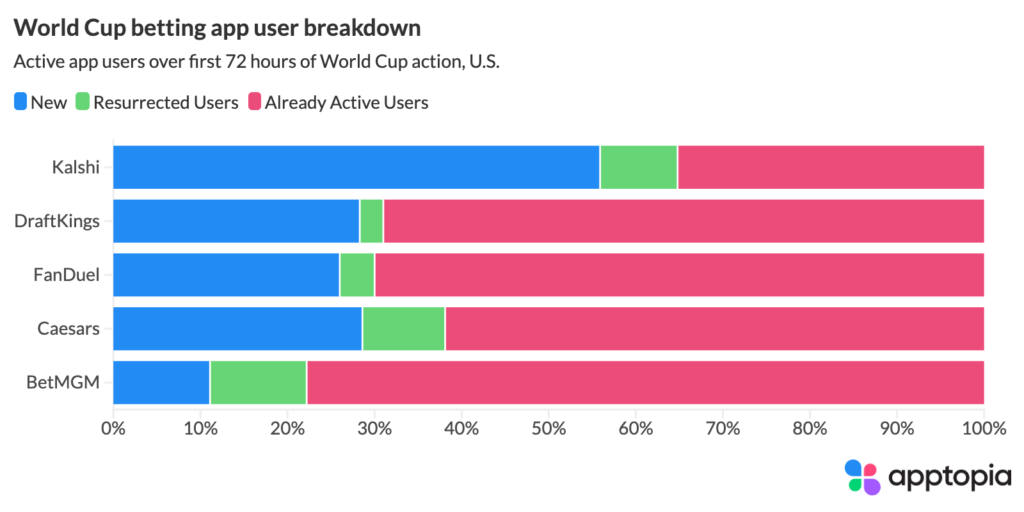
A New User is defined as one that has never had a session on the app prior to June 11th, the first day of the World Cup. A Resurrected User is one that had churned but then had a valid session within the first 72 hours of the World Cup. Churned users are those who did not have any activity on the app for at least 30 days prior to June 11th, the first day of the World Cup.
“The sportsbooks are defending a base they spent years and a lot of marketing dollars to acquire, and the World Cup is showing up for them as nurturing their existing audience rather than generating fresh signups,” said Tom Grant, VP of Research at Apptopia. “We’ve found about 80% of Kalshi users do not use any OSB app in a given month, meaning they are building a different and arguably more durable audience.”
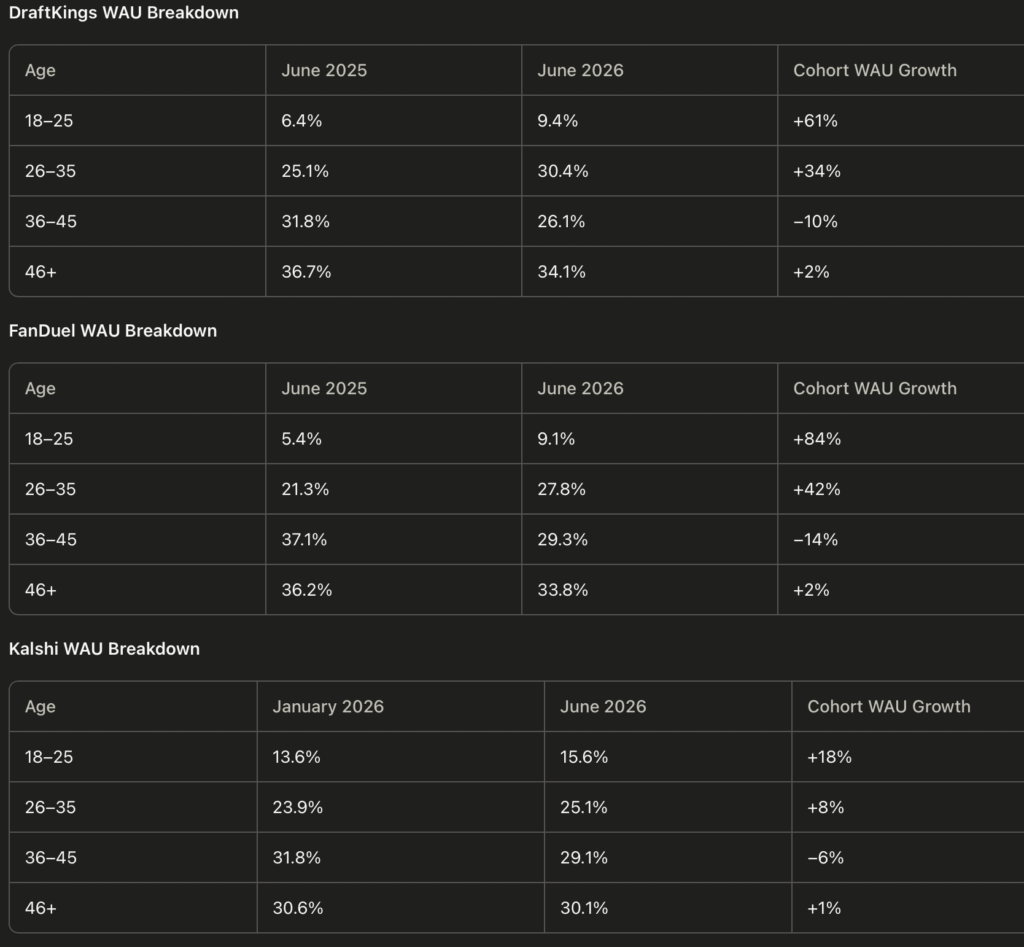
Younger users, those aged 18-25, are the fastest growing segment of bettors for DraftKings, FanDuel and Kalshi. Kalshi’s breakdown takes from January 2026 instead of June 2025 because the app needed to reach a certain level of maturity before looking at where user growth is coming from currently.
Kalshi also has the highest percentage of its users in the youngest bracket, compared with the others. Still, each app has the largest share of its users coming from the 46+ age bucket. Each app also has negative growth from the 36-45 bucket. It looks like betting is starting to skew younger, slowly as growth in the 46+ cohort is barely above negative. We’ll take another look at how things are progressing at the end of June, when we reach the halfway point of the World Cup.