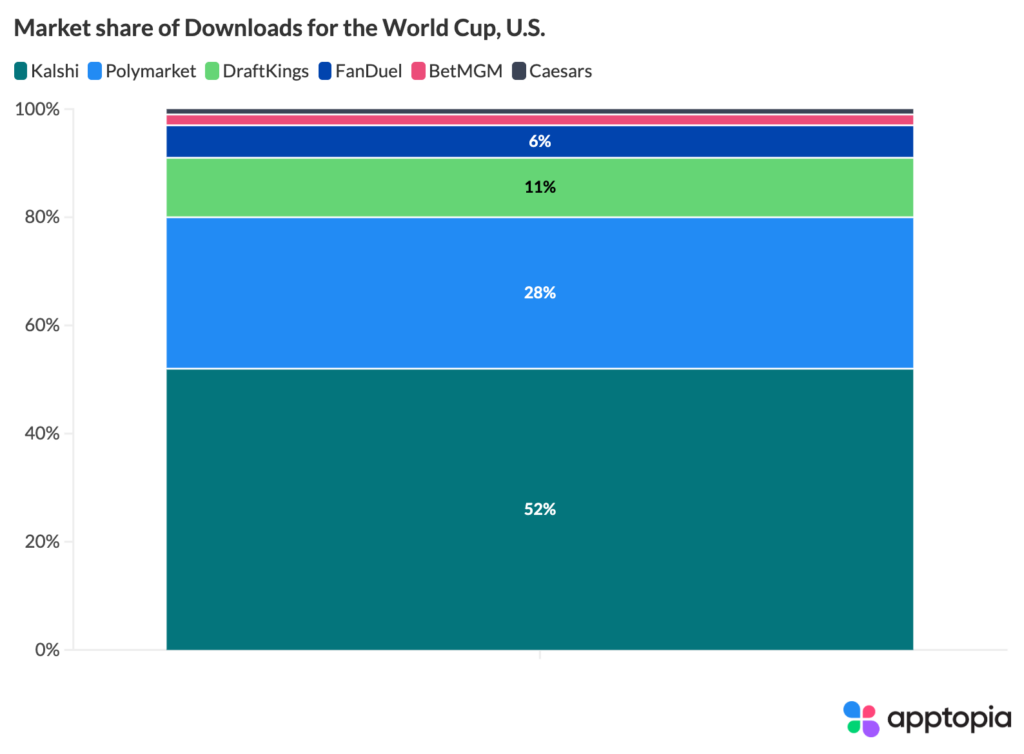
Prediction markets dominated when it comes to new users, accounting for 80% of the market’s downloads. People may argue that users can bet on anything in Kalshi and Polymarket, not just sports. While that is true, there are non-sports bets available inside the prediction market sections of DraftKings and FanDuel as well.
I want state that this article will be the culmination of our World Cup coverage of the OSB and prediction market apps. We’ve had three installations so far:
2026 World Cup Reverses Seasonal Lull for Sports Betting Apps
Prediction Markets Are Dominating New Bettor Acquisition During the World Cup
Sportbooks’ World Cup DAUs Peaked on June 15. Kalshi’s Never Stopped Climbing.
After The Trophy: Are World Cup Users Staying Around?
Historically, Kalshi has had higher churn rates than the sportsbooks. This is typical of newer apps running massive user acquisition campaigns. There are a lot of people suddenly hearing about and then trialing the app. Every time there is an event, Apptopia is able to track new users, resurrected users, and already active users. Our focus for this section is new users.
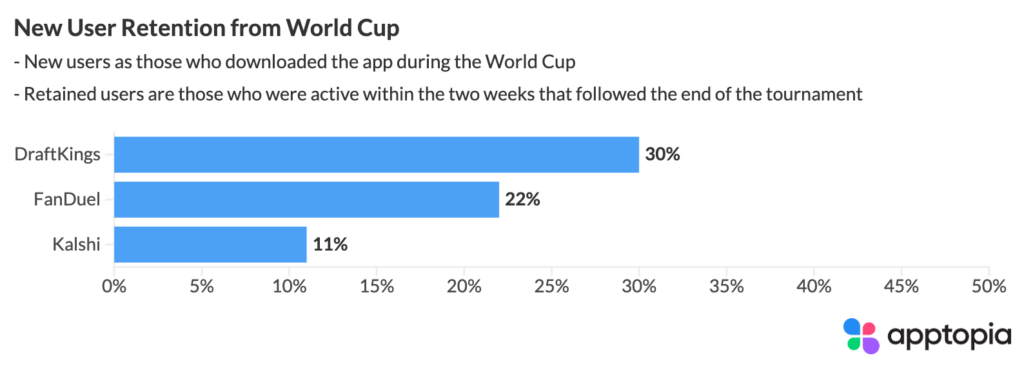
In this situation, we’re defining new users as those who downloaded the app during the World Cup. Two weeks later, 11% of those remain active on Kalshi. That number is 30% for DraftKings and 22% for FanDuel. Looking at absolute number of devices, because of the massive amount of new users Kalshi gained, it’s 11% is a larger number than DraftKings’ 30%. Just because people are not active within this two week window does not mean they won’t come back for another major sporting event.
Is Kalshi Stealing OSB Users?
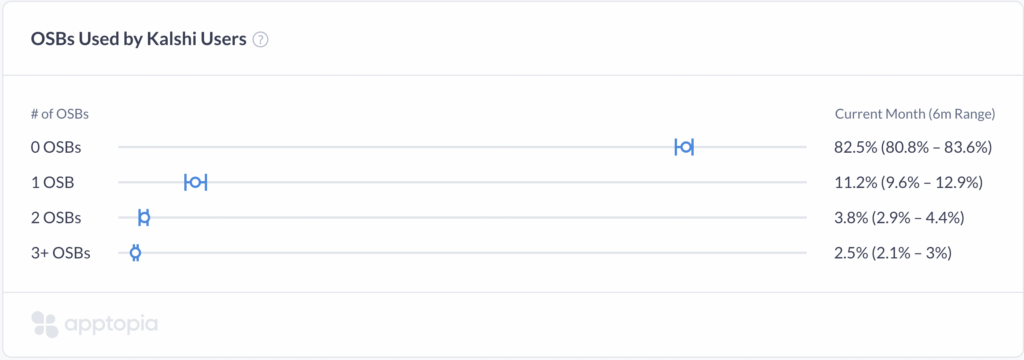
Kalshi looks to be expanding the betting market more than it is stealing from it. Most Kalshi users (79% in July) are not using sportsbooks but the number of sportsbook-first users who are using Kalshi has been increasing.
Even though most Kalshi users are not using OSB apps, a cluster of DraftKings users are getting curious. The percentage of DraftKings users using Kalshi went from ~10% in May to ~18% during the World Cup. Even after the tournament, that number remains elevated over May, at just under 15%. Looking at the opposite side of things, Kalshi users using DraftKings remains largely flat, around 8%.
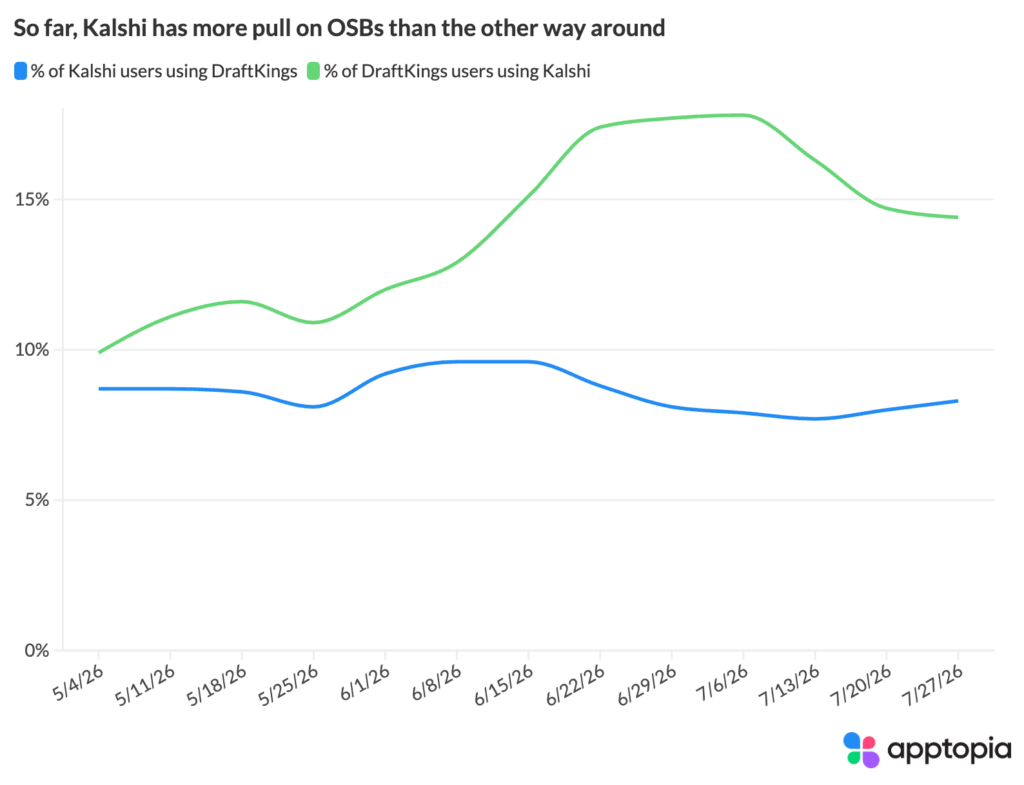
To me, it makes sense that a sports bettor would want to investigate Kalshi. Are their odds better? Do they have different bets that I like that are not available on DraftKings? Whereas Kalshi users are mostly new to betting and only a small portion will “graduate” to more advanced sports betting.
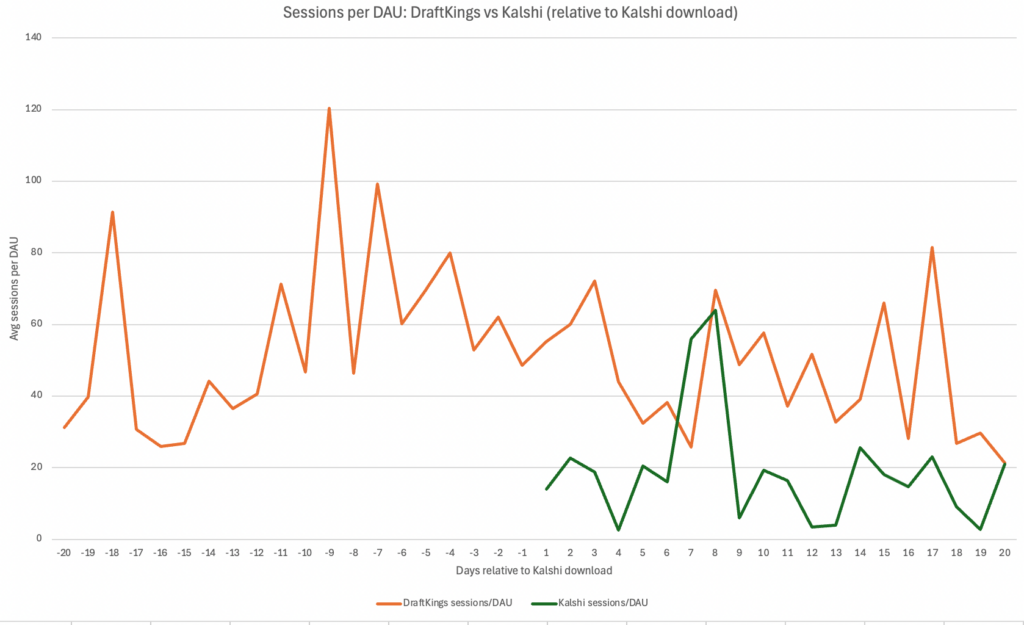
We analyzed DraftKings Sportsbook users who downloaded Kalshi in June (above). Before installing Kalshi, they averaged 56.2 sessions per DAU. After installing Kalshi, sessions per DAU dropped 18.4% to 45.9. However, they are continuing to use the sportsbooks more than Kalshi because this cohort averaged 18.9 sessions per DAU on Kalshi. Their total engagement with betting increased, as these users went from the aforementioned 56.2 sessions per DAU to 65.0, a 15.7% increase.
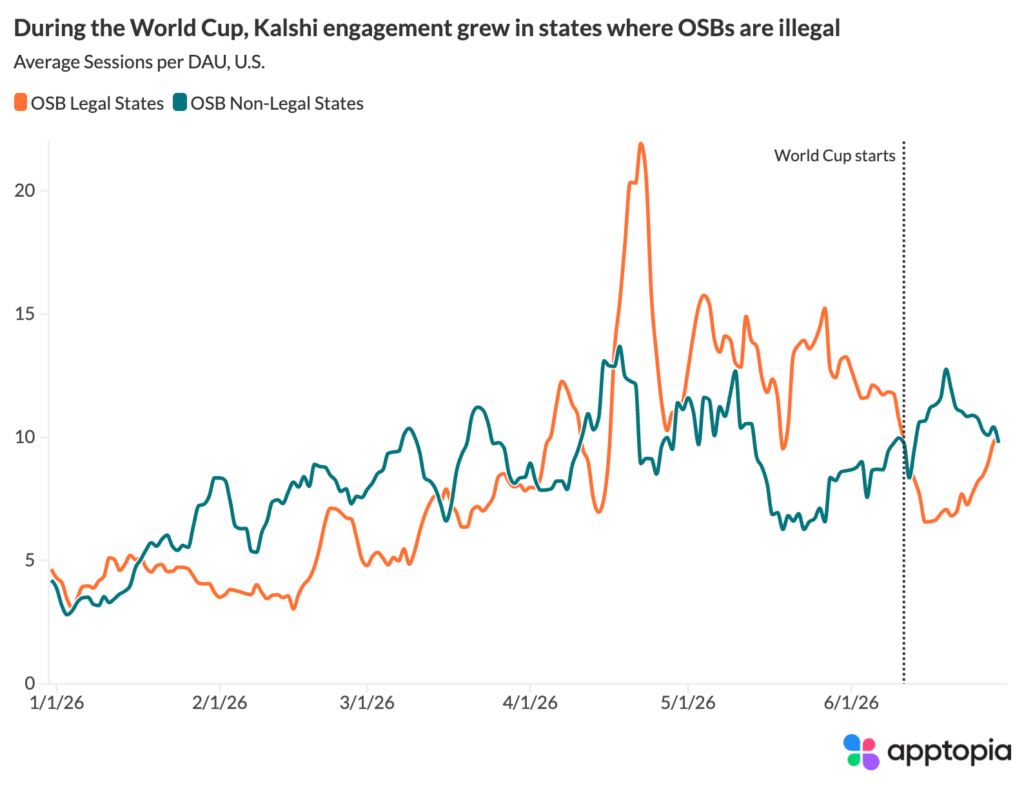
Does Kalshi have more users from states where sports betting is illegal?
Historically, there has not been much difference between number of users from states where sports betting is legal and those where it is not. Looking at market share percentages, they ebb and flow tightly together. Engagement is tightly bound together as well, but during the World Cup, users from states where sports betting is illegal engaged more with Kalshi than those where they could bet on more platforms.
Here is Apptopia CEO Jonathan Kay on the Bloomberg Intelligence show talking more about the growth journey of OSB and prediction market apps through the World Cup and the demographic differences between them: