Key Takeaways:
- Muse has 5.8 million downloads in its first 20 days of launch
- Muse users skew older than those of the top GenAI chatbots, while opening the app nearly as much
- Since the launch of Muse, DAUs of Meta AI in the U.S. have fallen 36%
Twenty days after launch, Meta’s Muse has racked up 5.8 million downloads across the US and Canada, with 95.5% of those coming from the United States. In the US, launch DAUs are above those of ChatGPT and other rivals. Muse has benefitted from easily advertising to its own massive audience and a more mature consumer AI market.
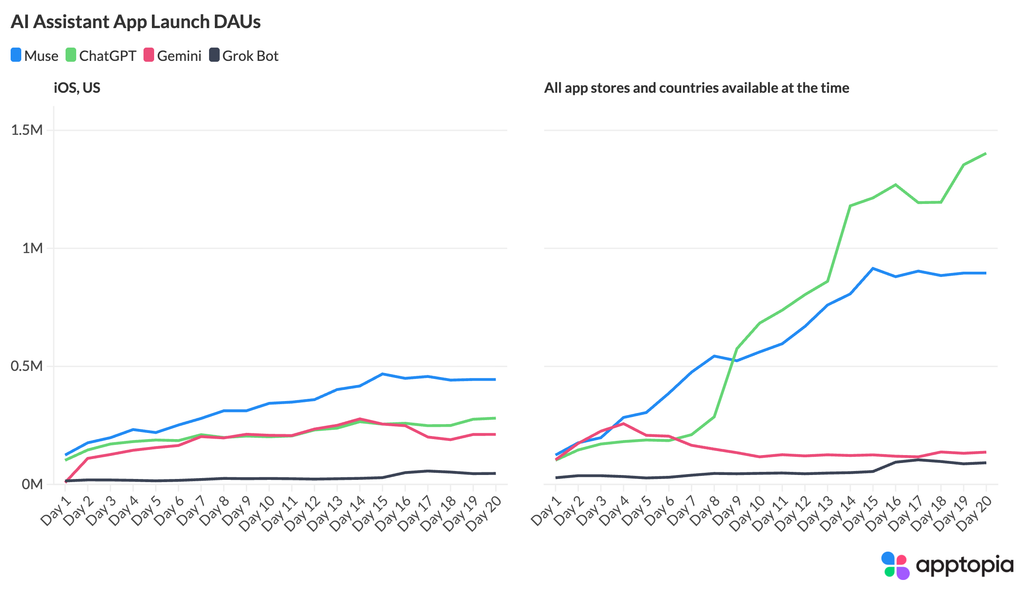
I want to put forth context for the above image, specifically the right side of it: ChatGPT launched globally whereas Muse only launched in the US, followed by Canada 11 days later. ChatGPT also only launched on iOS, launching on Google Play roughly two months later. Grok Bot launched globally on iOS, followed by Google Play 18 days later. Google Gemini launched on Google Play, just in the US. It did not launch on iOS until nine months later.
Who are the Musers?
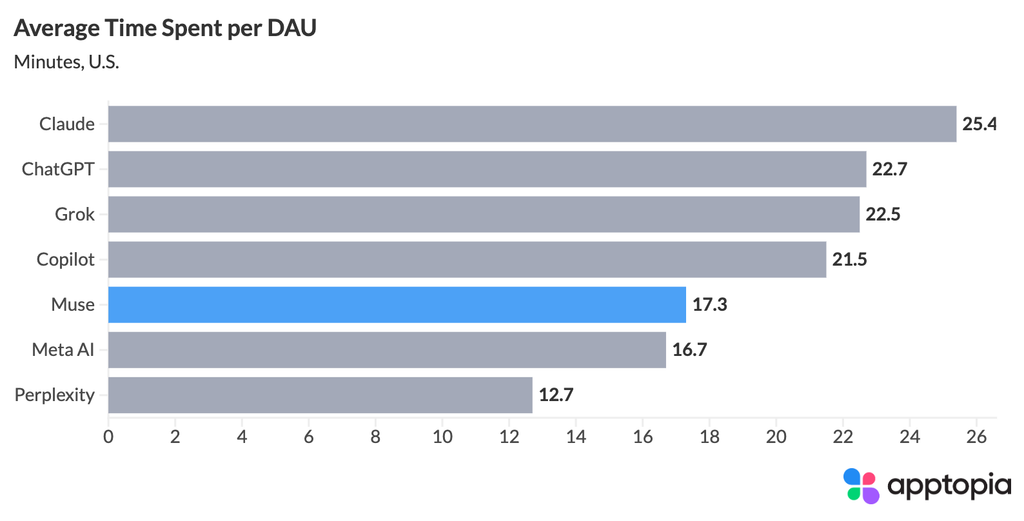
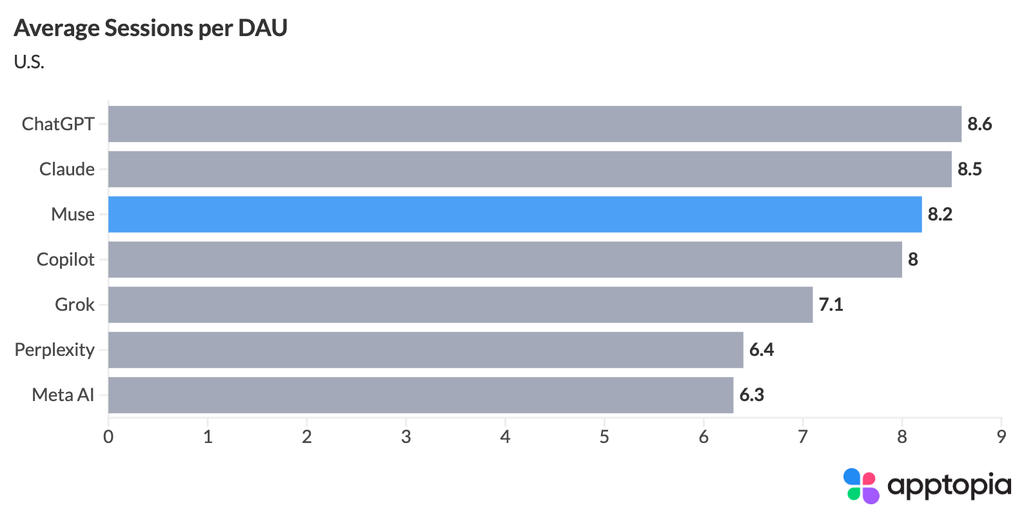
Muse users open the app almost as often as ChatGPT and Claude but spend less time in it. It could be the app still needs more user familiarity or it could be that the app is more efficient in its use case compared to a traditional LLM chatbot.
Looking at US demographics, both Muse and ChatGPT are close to 50/50 gender use split, with ChatGPT leaning slightly female and Muse leaning slightly male. Where Muse really differs is in age. Almost half (46%) of its users are aged 46+ whereas ChatGPT is much more evenly spread across age cohorts, though skewing younger as we go down through our standard age brackets. 21% of ChatGPT users are aged 46+ while 29% are aged 17-25. For Muse, 10% of its users are aged 17-25.
Muse skews older than every GenAI chatbot app. The closest is Microsoft Copilot with 39% of its users falling into the 46+ age band. This makes sense as it is largely an enterprise user base where employers are paying for these people to use it. Muse seems to be attractive, at least initially, to older consumers. It may be getting them into AI more broadly (see Suno and ChatGPT in the chart below).
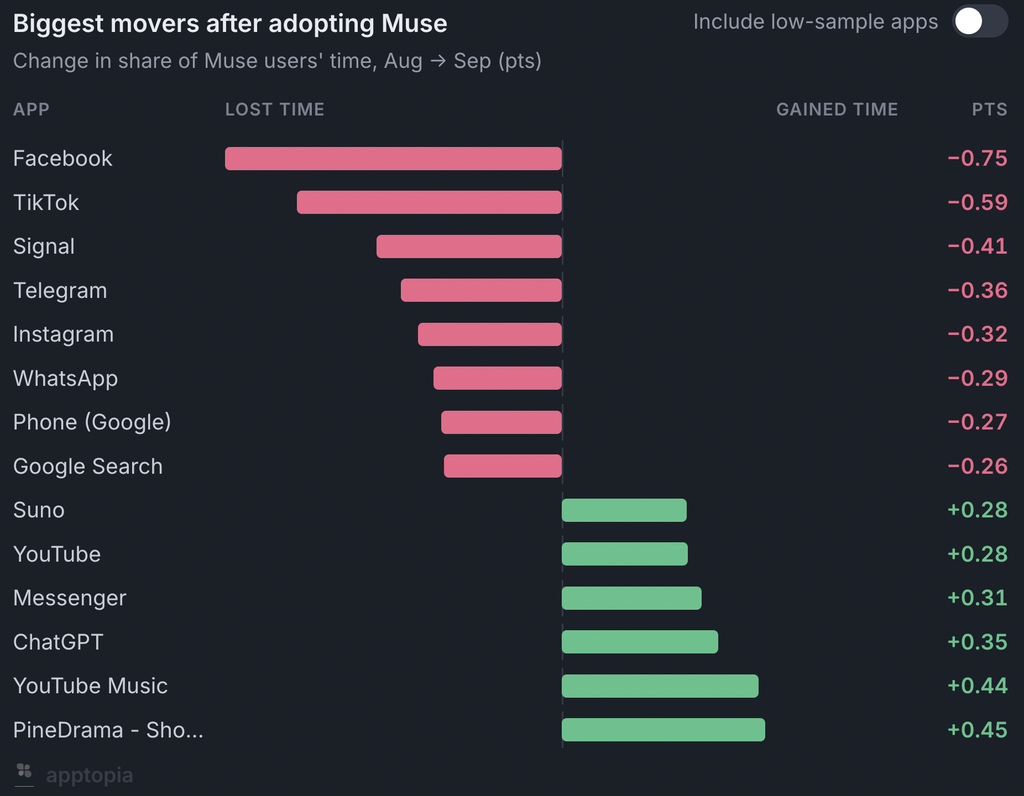
We looked at Muse users to determine where they were spending more and less time now that Muse is part of their time spent on mobile. Facebook saw the largest drop, which makes sense when you remember most Facebook users and Muse users are aged 46 or older. It is also where Muse ran a lot of its user acquisition campaigns. Another app seeing a fall in time spent was Google Search, which AI has been disrupting for awhile now. Apptopia VP of Research Tom Grant elaborated on businesses at risk if Muse adoption strengthens:
“Meta’s Muse is an AI assistant that can act on a person’s behalf, which makes it dangerous to any business that sits between a consumer and a decision: A Peloton subscription, eBay as a place to search for a product, DoorDash or Expedia charging a convenience fee, NerdWallet and budget tracking apps, even Google is exposed if people start asking Muse to just handle it for them.”
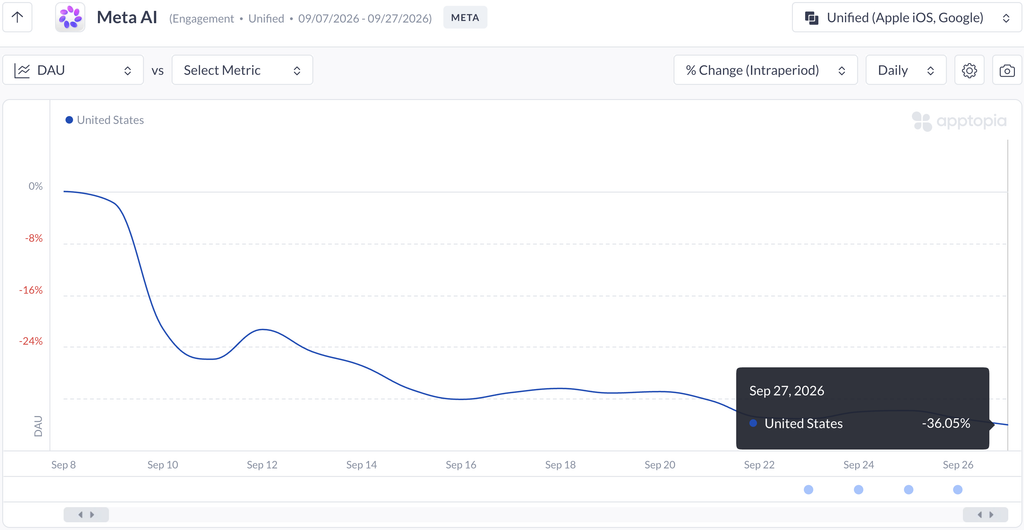
Since Muse debuted, Meta AI has been losing DAUs in the United States to the tune of 36%. I believe Muse has essentially rendered Meta AI useless since it can do everything Meta AI can do and more.