Key Takeaways:
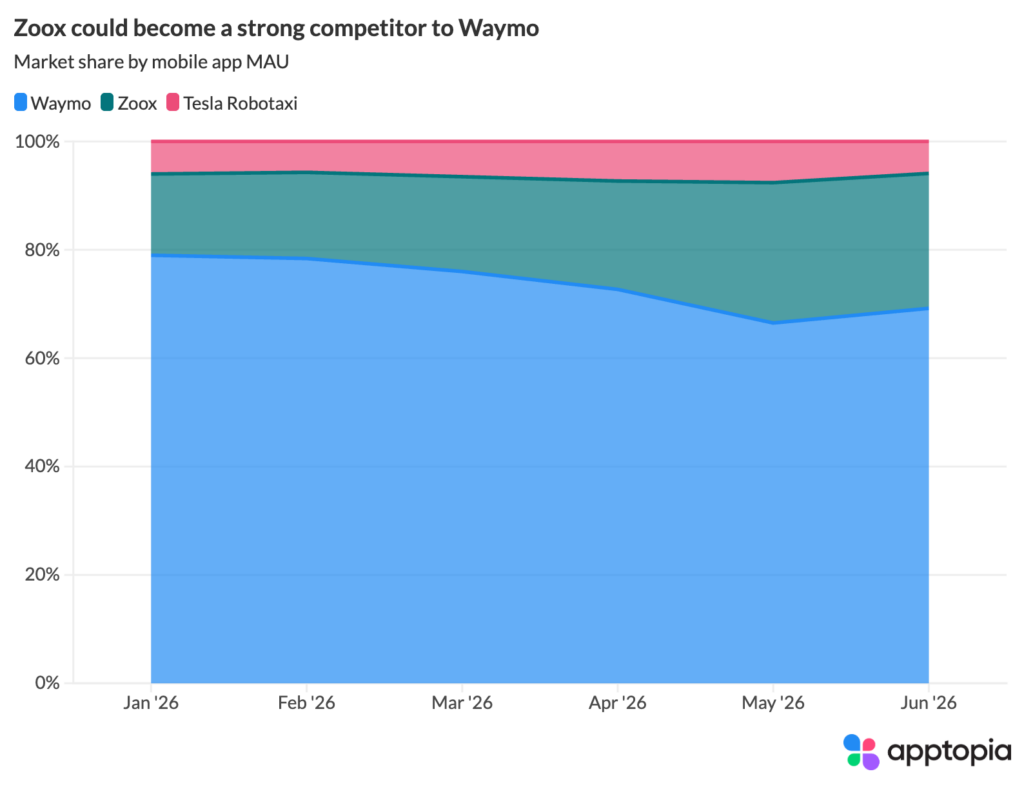
- Waymo still owns roughly seven of ten robotaxi app users, but its share of the three major players slipped from about 79% in January to 69% in June as its Y/Y MAU growth cooled from 79% to 15%.
- Zoox more than doubled its monthly active user base in the first half, lifting its share from 15% to 25%, the clearest sign yet of a credible number two.
- Tesla Robotaxi’s usage jumped after its April city launches, then shed more than a fifth of its active users in June. Expansion headlines and durable ridership are not the same thing.
The robotaxi market spent two years as a single-name story. Waymo [NASDAQ: GOOGL] built the lead, logged the miles, raised the money, and everyone else was measured against it. The first half of 2026 is the first stretch where the consumer app data shows that framing loosening.
Waymo still commands close to 70% of monthly active users across itself, Zoox, and Tesla Robotaxi. However, its year-over-year MAU growth decelerated every month this year, from 79% in January to 15% in June. Some of that is simple math, since the largest player grows slowest off the biggest base. The more useful read is where the users are going instead.
Part of the answer is inside Waymo’s own base. Its 17-25 age cohort was a rounding error in January and grew several times over by June to become a real slice of active users. User Churn in that band fell from near-total early in the year to roughly 60% by June. Rising adoption and falling churn in the same cohort is the pattern that signals habit forming rather than a one-time try. Meanwhile Waymo’s core 26-45 riders lost penetration over the same stretch. The flat headline is masking a trade: mature-user saturation for a fast-growing young base that maps to the freeway rollout and Sun Belt expansion into student-heavy metros. Younger riders age into the highest-value years for a category built on habit, which makes this the more encouraging half of an otherwise soft growth print.
Amazon’s [NASDAQ: AMZN] autonomous unit roughly doubled its monthly active users between January and June and pulled its share of the three-app set from 15% to a quarter of the market. The inflection lines up with operations, not necessarily marketing. In late March, Zoox quadrupled its San Francisco service area, more than doubled its Las Vegas footprint, began public deployments in Austin and Miami, and put its vehicles on the Uber app in Las Vegas. When a service opens up geography, the app is where demand shows up first, and Zoox’s numbers moved accordingly.
Tesla is the harder case to read, and the more interesting one for anyone underwriting the stock’s autonomy narrative. Tesla Robotaxi [NASDAQ: TSLA] downloads more than doubled from January to their April peak as the company launched unsupervised rides in Dallas and Houston ahead of schedule. Active users followed to a May high, then fell more than 20% in June even as the app stayed live in its markets. New cities generated a wave of trial but much of it did not stick.
“The bull case treats Tesla’s robotaxi as a question of when, not if, so a month where active users fall after a multi-city launch is the kind of thing worth sitting with,” said Tom Grant, VP of Research at Apptopia. “Trial is easy to manufacture with new cities and a launch cycle; retention is the part you can’t fake. Right now the app data says Waymo and Zoox are keeping riders and Tesla is still proving it can.”
One caveat before over-reading a single month: summer travel and tourism markets like Las Vegas and Miami inflate trials across all three apps, which makes retention the cleaner signal than installs. On that measure Zoox held its new users while Tesla’s cohort thinned.
None of this dents the structural point that Waymo is years ahead in driverless miles and commercial cities, and it raised $16 billion at a $126 billion valuation to keep that lead durable. What the app data reframes is the question. For two years the only relevant number was how fast Waymo could grow. Now it is how much new demand Waymo keeps, because Zoox is competing for it in the same neighborhoods, and Tesla’s June dip is answerable in the usage data before it reaches an earnings call.