Key Takeaways:
- The online sportsbook app market grew MAU 10.7% YoY but DAU fell 4.7% YoY in 1Q26.
- Average Sessions per DAU of FanDuel Sportsbook’s Power Users have been down year-over-year for 7 consecutive quarters. For DraftKings Sportsbook, it’s 3 consecutive quarters.
- Kalshi looks less and less like an OSB cannibalization story. Roughly 80% of Kalshi users don’t use any OSB app, the cohort is younger and more female.
While MAU grew 10.7% for the US sportsbook market, DAU shrunk 4.7% YoY in Q1 2026. When MAU increases and DAU decreases, this points to a decrease in engagement. The market includes eight apps. DraftKings Sportsbook [NASDAQ: DKNG] grew its market share of US MAUs from 33.6% in 1Q25 to 35.5% in 1Q26. FanDuel Sportsbook [NYSE: FLUT] remains the share leader at 36.7% in Q1 2026, down modestly from 37.8% a year ago.
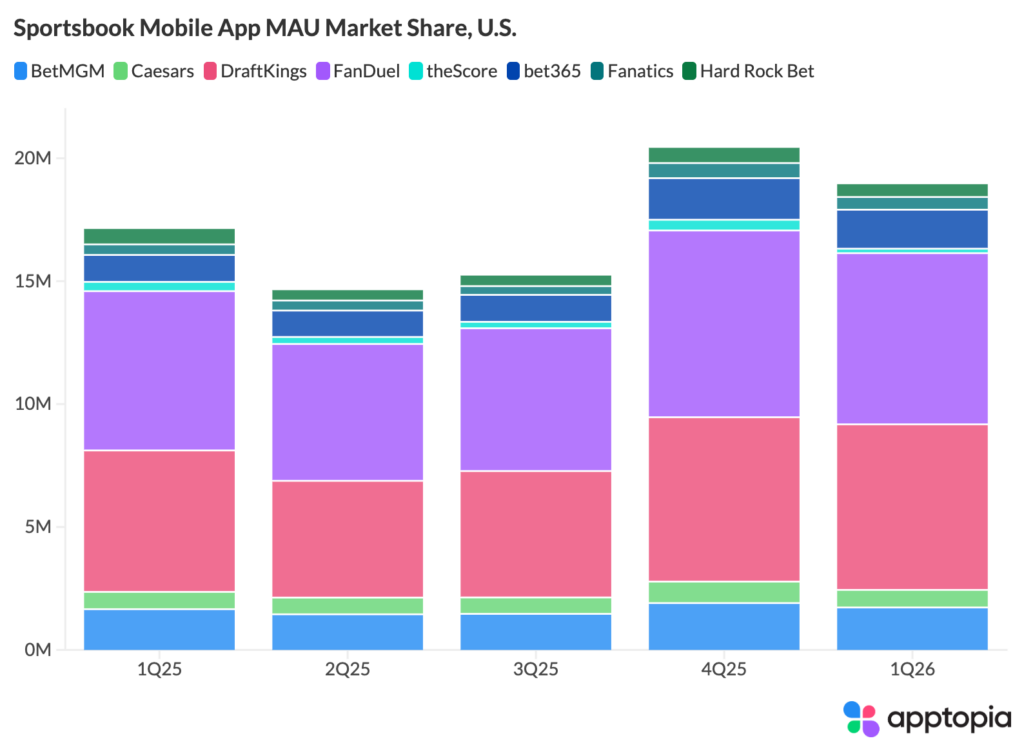
Bet365 gained two points, increasing share from 6.4% to 8.4%. BetMGM [NYSE: MGM] has fallen from 11.7% share in 1Q24 to a 9.1% share in 1Q26. Caesars [NASDAQ: CZR] slipped roughly 0.3 points (4.1% to 3.8%). Total OSB MAU across the eight apps grew over the year, with each app, except for theScore [NASDAQ: PENN] and Hard Rock Bet, growing MAU year-over-year in the first quarter.
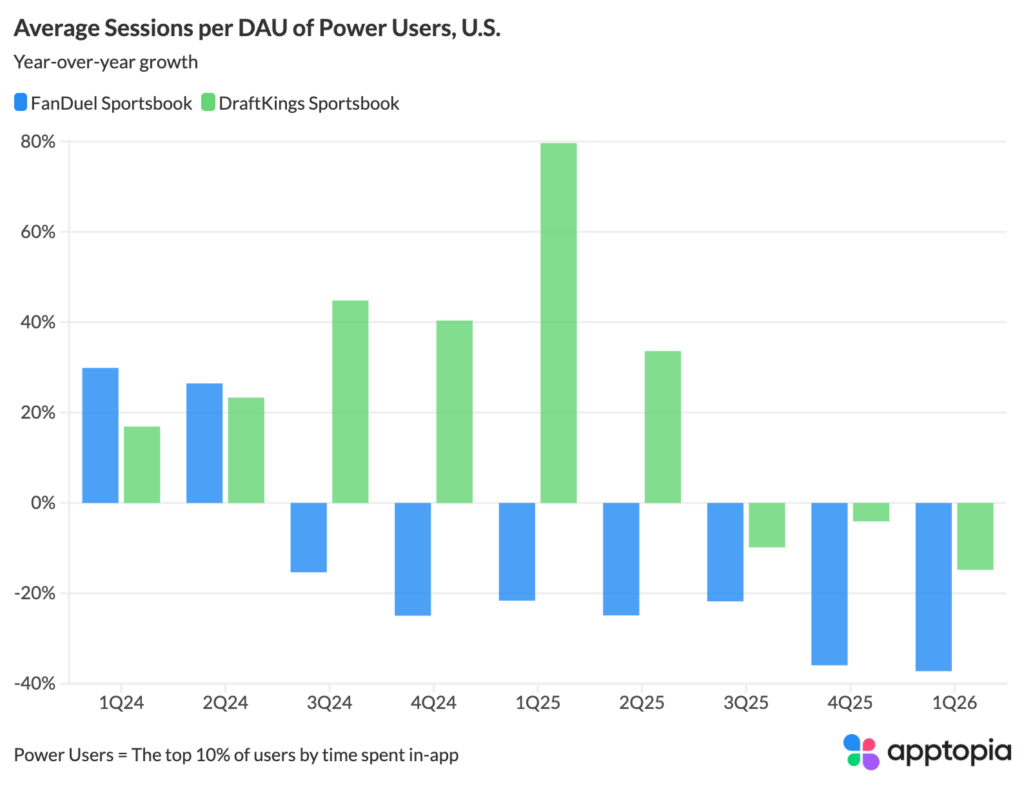
The engagement data points the same direction. DraftKings’ average sessions per DAU in Q1 2026 was 13.2, well above FanDuel’s 9.0 and roughly double theScore’s 5.3. DraftKings power users, the top 10% by time spent, averaged 51.8 sessions per DAU in the quarter, the highest in the group. FanDuel’s power user sessions are down 37.2% YoY. This may help explain why the share gap between FanDuel and DraftKings. Even with average sessions falling, the apps are gaining users. Monthly active users for DraftKings Sportsbook are up 34.7% year-over-year in April. FanDuel Sportsbook is up 20.8%.
Prediction market user acquisition slows
It’s been reported that roughly 90% of Kalshi’s money wagered is for sports-linked contracts. Given that, we’ve reviewed the prediction market apps and analyzed them to understand the competitive threats they pose to OSBs.
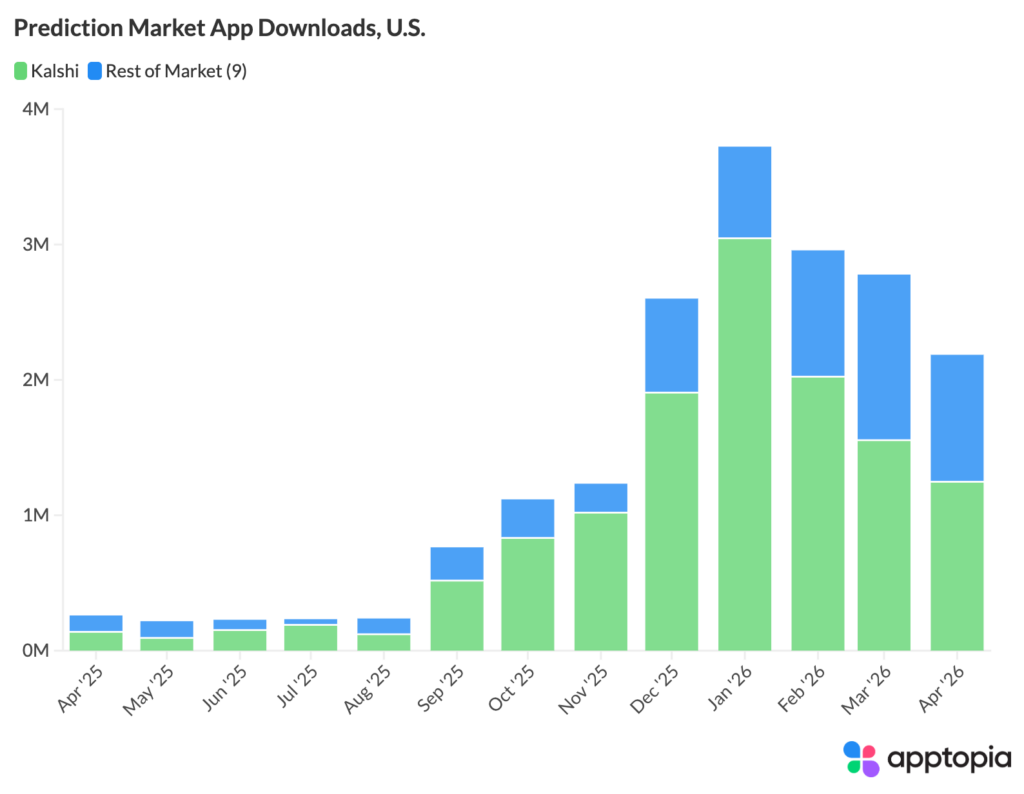
Total US downloads for the prediction market category peaked at 3.7 million in January 2026 and have fallen to 2.2 million in April, a 41% drop in three months. Year-to-date, Kalshi has averaged 65.8% of US prediction market app downloads, hitting as high as 81.8% in January.
FanDuel and DraftKings launched their own standalone prediction market apps in December 2025. FanDuel Predicts pulled in 227,057 downloads in April compared to DraftKings Predictions’ 62,694, roughly 3.6x. Something to remember is that DraftKings’ prediction market app is only available in states where its sportsbook is not. The magnitude of the gap is still notable, and worth tracking next quarter as both companies build out their event-contract operations.
Kalshi users differ from OSB users
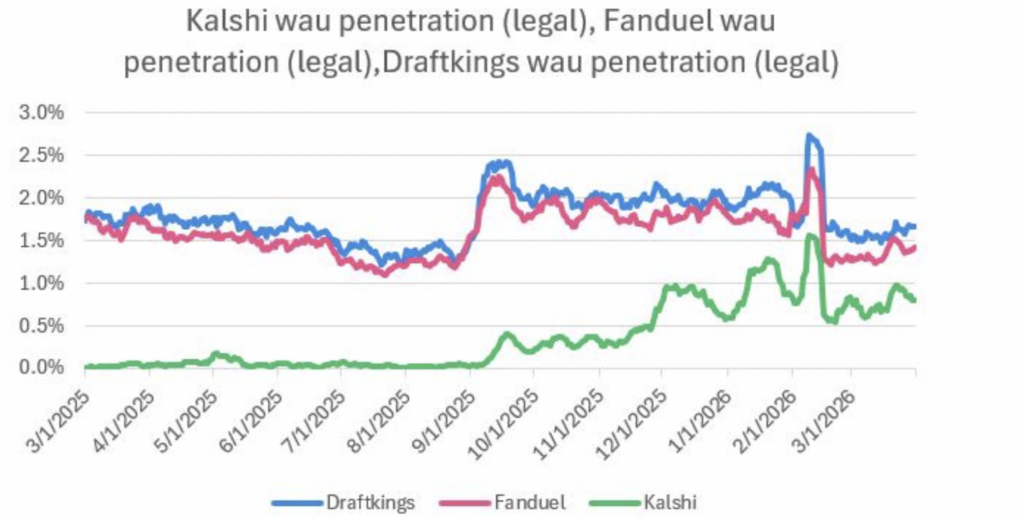
In states where OSB is legal, Kalshi is still seeing strong growth in weekly active users, with similar seasonality as OSB apps.
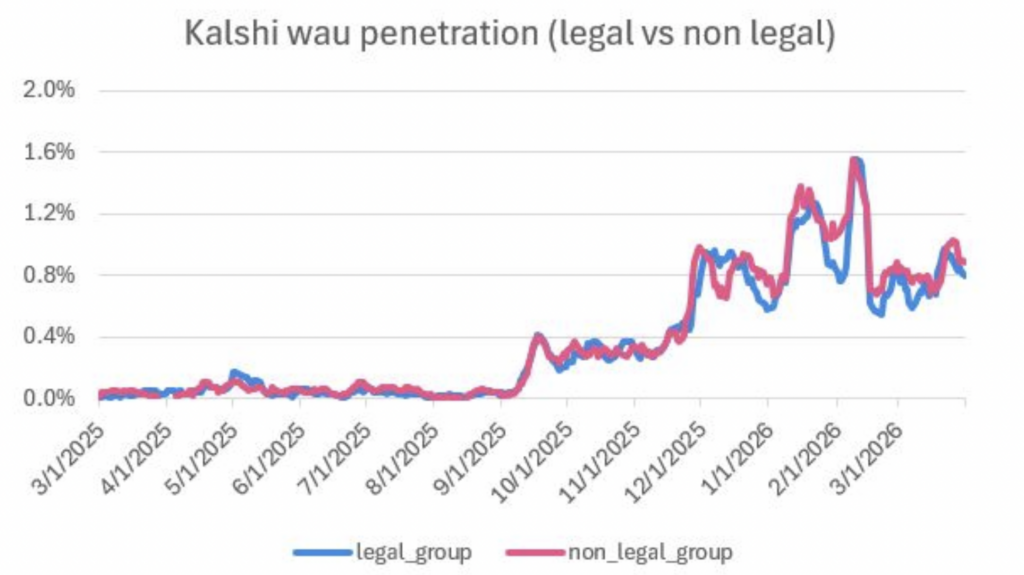
Looking at weekly active users of Kalshi in legal and non-legal states, the numbers and trends are almost identical. Given that users are growing in a very similar fashion regardless of OSB legality, Kalshi appears to be more of its own phenomenon than another OSB app.
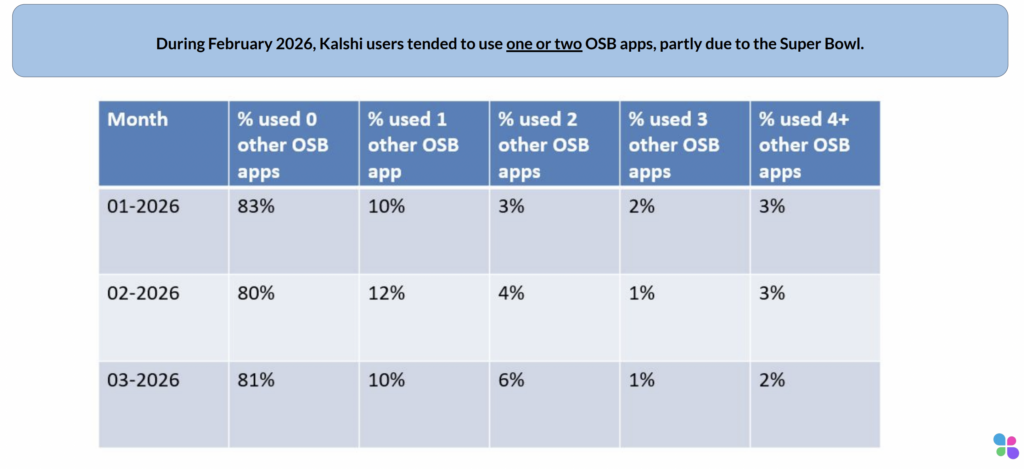
Furthermore, about 80% of Kalshi users do not use any OSB app in a given month, and that share has been stable across Jan, Feb, and Mar 2026. Cross-app overlap with DraftKings Sportsbook dropped from 22.2% in April 2025 to 8.2% in April 2026; overlap with FanDuel Sportsbook fell from 16.3% to 5.9%.
As Kalshi has scaled, its users have looked like a different breed of sports bettors. The Kalshi user base also skews younger (13.5% are 17–25 vs. ~8–9% for DraftKings and FanDuel) and more female (29.6% vs. ~23%). Kalshi’s simple Yes or No terminology on bets could be attracting people who would previously never bet on sports. Eventually, Kalshi could even act as a feeder into the sportsbooks apps for those who get more into it and learn the lingo. OSB apps have shown to have more engagement than prediction market apps.
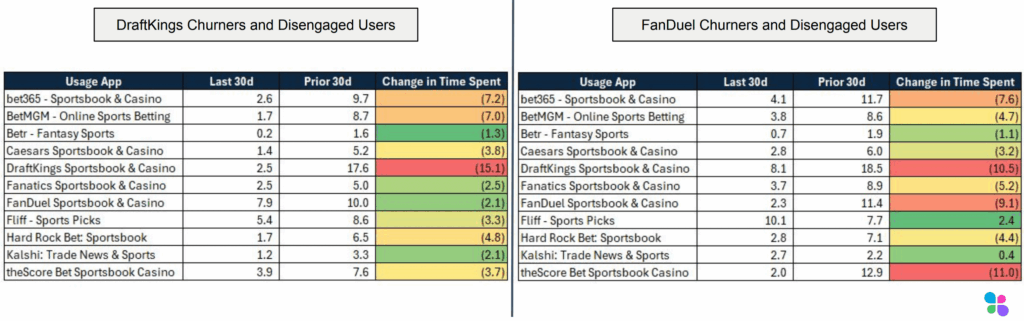
To drive the point home even further, we identified DraftKings and FanDuel sportsbook users who reduced their time spent by two thirds or more in February. Among these users, their time spent on OSB apps generally fell across the board instead of migrating to Kalshi or any other competitive app.
“The right question for analysts to be asking about Kalshi has shifted,” said Tom Grant, VP of Research at Apptopia. “Six months ago it was ‘how much of OSB revenue is at risk?’ Today it should be ‘how quickly can DraftKings and FanDuel convert prediction market curiosity into sportsbook accounts?’ The 80% non-overlap figure is a top-of-funnel opportunity hiding in plain sight.”
The rise of prediction markets like Kalshi does not appear to be the existential threat to sportsbooks that some analysts feared. Rather than cannibalizing existing OSB users, these platforms are expanding the total addressable market by attracting a younger, more diverse cohort that values simplicity and event-based contracts. As DraftKings and FanDuel continue to hone their own prediction market offerings, they are well-positioned to leverage these platforms as top-of-funnel acquisition tools, further solidifying their dominance in the evolving digital wagering ecosystem.