When LinkedIn’s data science team pushed the 360Brew feed-ranking model live, Apptopia’s user-level panel started picking up a clear acceleration in how much time people spend in the app. LinkedIn [NASDAQ: MSFT] now has the fastest-growing US engagement of any major social networking platform.
LinkedIn has not publicly stated that the feed is entirely powered by 360Brew or provided a complete rollout timeline. Given the inflection in the data around November 2025, this is when we assume there was a broad rollout of the new algorithm.
Time spent per user sat flat to slightly down for roughly 18 months, from 5.5 minutes in early 2024 to 5.3 by November 2025. Then it jumped 38% in the next six months, to 7.3 by May 2026, as 360Brew’s algorithm began rolling out across the feed. LinkedIn moved from a network-based feed (who you know) to an interest-based one (what you actually read), and tuned ranking around dwell time instead of likes. Microsoft doesn’t break out LinkedIn engagement, but it did report LinkedIn revenue up 11% year-over-year and paid video ad volume up 30% (Microsoft FY26 Q2), consistent with a feed pulling people in deeper.
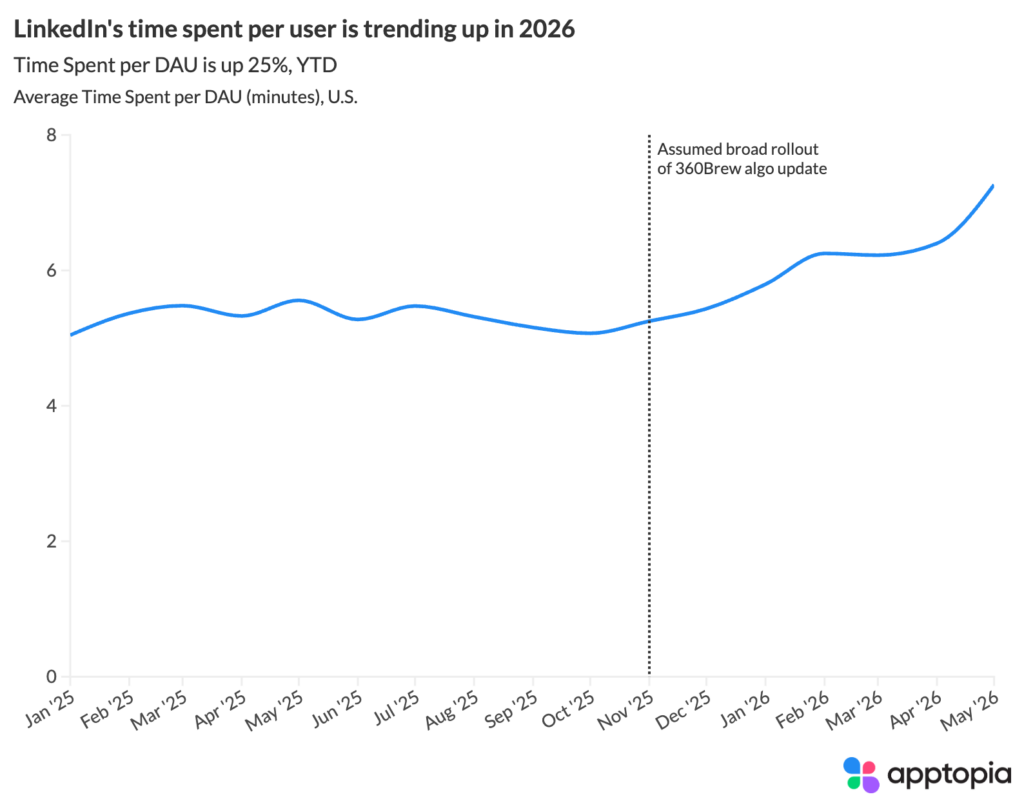
Across the US, time spent per DAU is up 25% year-to-date through May 2026, the highest of the seven apps in our set. For context, the apps people already think of as the most engaging social networks, names like Instagram and Facebook, Reddit, Snapchat, Pinterest, and TikTok, are mostly flat or declining on the same measure. Instagram is the only other one in positive territory, and it’s up about 6%.
The growth is not evenly spread. Two cohorts are doing the heavy lifting. Time spent per user among the 17-25 group is up 52% year-to-date, and the 46+ group is up 43%. The traditional mid-career professional, the 26-35 cohort LinkedIn was built around, is the only group going backward, down 4% this year and down 15% since early 2024. The user base is tilting in the same direction. The 46+ cohort has grown from 39% to 42% of LinkedIn’s weekly active users since early 2024 and is now its largest age group, while the 26-35 share has slipped from 23% to 21%.