McDonald’s [NYSE: MCD] leads the QSR industry in downloads, sessions, and daily active users. That much is well documented. What we wanted to know is what happens when a consumer opens a fast food app and decides not to order. Where do they go next?
Using Apptopia’s U.S. consumer device panel, we tracked QSR app sessions that were immediately followed by another QSR app session (within 60 seconds), and with no intervening app usage. The mobile equivalent of pulling into a drive-thru, scanning the menu board, and driving next door.
The short answer: a lot of people drive next door and most of them end up at McDonald’s.
We found that 15-25% of QSR app sessions are followed by an immediate visit to a competing QSR app, depending on the chain. That is a significant number. It means that on any given day, roughly one in five fast food app sessions doesn’t convert. The user opens the app, browses, and bounces to a competitor. For an industry that has invested billions in loyalty programs, app-exclusive pricing, and personalized deals, that leakage rate should raise eyebrows.
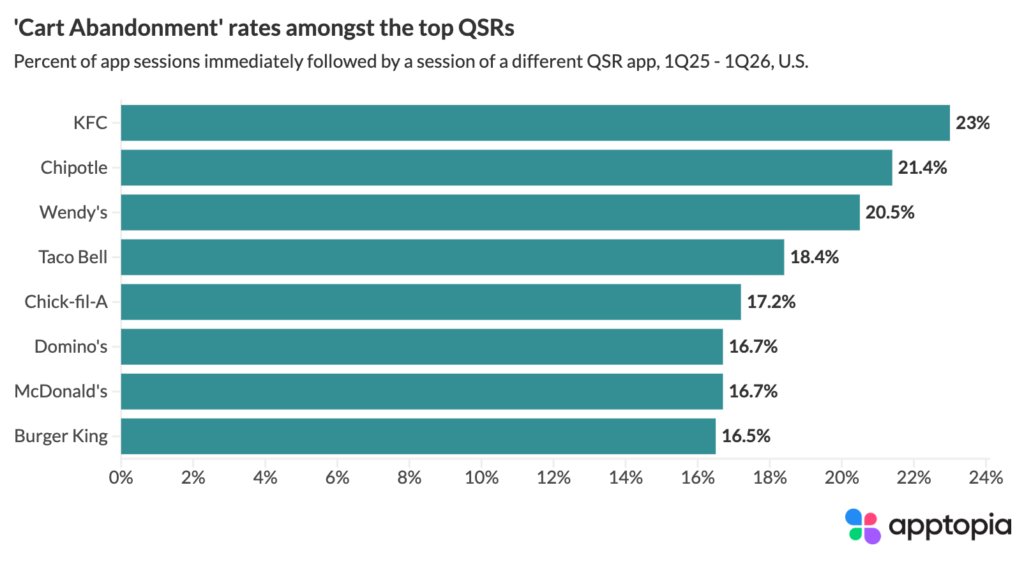
KFC [NYSE: YUM] has the biggest problem. Nearly one in four KFC app sessions (24.4% in Q1 2025) were followed by a competing QSR app session. That rate never dropped below 22% across five quarters of data. Chipotle [NYSE: CMG] ran about 21%, and Wendy’s [NASDAQ: WEN] hovered around 20%. At the other end, McDonald’s and Chick-fil-A were the tightest, both sitting in the 15-17% range for most of the period we analyzed.
“McDonald’s position as the default second choice has implications beyond market share,” said Tom Grant, VP of Research at Apptopia. “It means McDonald’s is effectively the price discovery mechanism for the entire QSR category. When consumers comparison shop, they’re benchmarking against the McDonald’s app. That gives McDonald’s an outsized ability to set pricing expectations for the industry, which is something investors should be watching as value menu wars intensify heading into the back half of 2026.”
But here’s what makes the data more interesting: no single competitor is stealing anyone’s lunch. The highest individual app-to-app leakage rate we found was Wendy’s to McDonald’s at 1.42%. Burger King [NYSE: QSR] to McDonald’s was 1.35%. These are small numbers in isolation. The comparison shopping isn’t concentrated. It’s diffuse, spread across dozens of apps, a little here and a little there. The aggregate effect, though, is substantial.
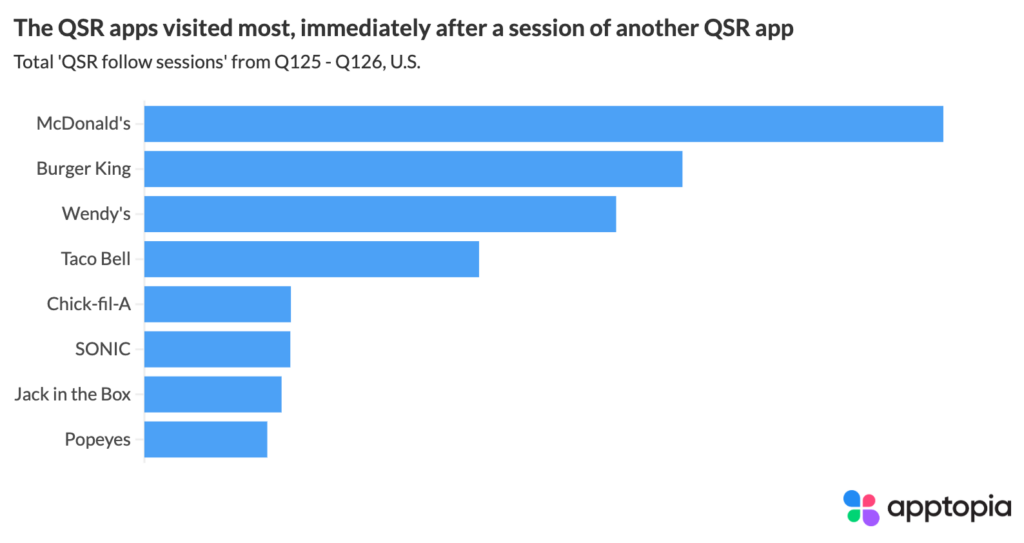
And when you follow those scattered sessions to their destinations, a clear pattern emerges. McDonald’s is the No. 1 follow-destination from virtually every other QSR app we tracked, in every quarter from Q1 2025 through Q1 2026. In Q4 2025, McDonald’s captured 48% more follow sessions from other QSR apps than Burger King, which was second. McDonald’s captured 87% more than Wendy’s, which was third. This ranking did not change once in the past five quarters.
McDonald’s isn’t just winning the first-choice decision. It’s winning the second-choice decision, too. It has become the default fallback for American fast food, the place consumers go when they can’t find what they want somewhere else. Part of that is simply availability and menu breadth. But the app itself deserves credit. McDonald’s has been aggressive with time-limited deals and personalized offers that give comparison shoppers a reason to check in before committing elsewhere.
The competitive implication is worth sitting with. Every QSR brand is losing sessions to comparison shopping. That’s unavoidable. But the sessions McDonald’s loses get distributed across a fragmented field. The sessions everyone else loses flow disproportionately to one place. McDonald’s is both the least leaky app and the biggest beneficiary of everyone else’s leakage. That is a compounding advantage, and the data suggests it’s durable.
Methodology: Apptopia analyzed QSR app session data from its consumer device panel, Q1 2025 through Q1 2026. A “follow session” is defined as a QSR app session that occurs as the very next session after an initial QSR app session, with no intervening sessions, within 60 seconds of the initial session ending. The analysis covers 10 base QSR apps across approximately 50 potential follow-on QSR apps per quarter.